Upload your course material
Drop in a course PDF, textbook, past paper, or notes. Kora reads the file and keeps every tool tied to that course.
Study cards, cheat sheets, practice exams, and guided methods — all from your material. Ask Kora explains the hard parts from your own pages.
Free to start. No credit card.
Neural Networks · Card 3 of 24
What does ReLU do to negative inputs?
Tap to flipHow it works
Drop in a course PDF, textbook, past paper, or notes. Kora reads the file and keeps every tool tied to that course.
From that material she puts together a plan, flashcards, practice exams, a knowledge map, cheat sheets, and lecture notes — in one place.
Work through the tools, and ask Kora to explain a concept using your course, not the open web.
The study system
Not a chatbot with a study prompt bolted on. A workspace where your PDF, your plan, and your practice live together.
Browse every featureDrop in your PDF textbook or course guide. Kora reads every page, identifies the topics, and turns them into a study plan — with chapter references, estimated times, and a learning order. The same file then feeds your cards, exams, notes, and the rest of the system.
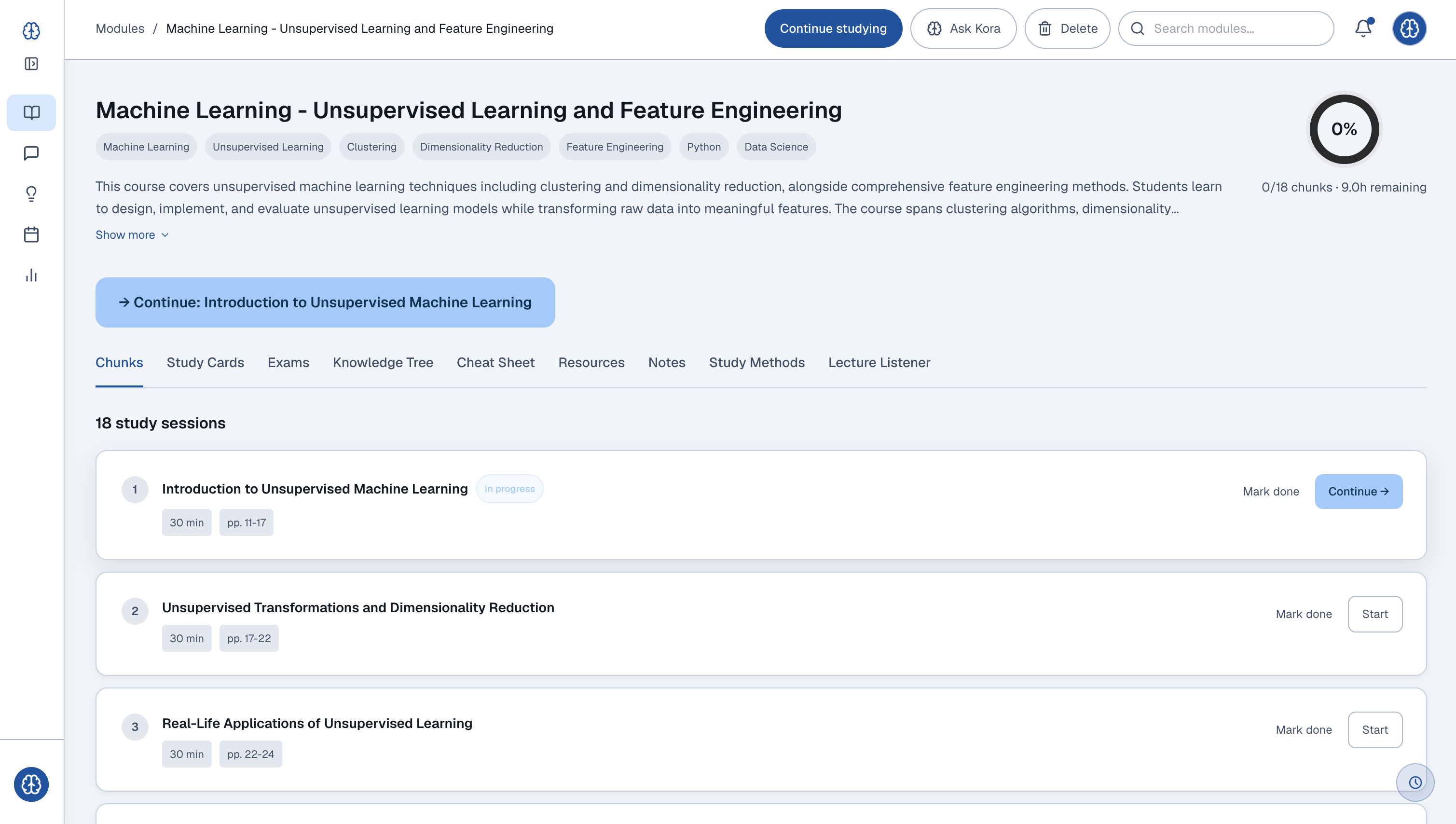
Neural Networks
22 topics · 8.5 hours
Introduction to perceptrons
pp. 12–28
Backpropagation fundamentals
pp. 29–51
Activation functions
pp. 52–68
6 of 22 complete
Kora reads your course material and generates flashcards from the concepts that matter — not generic questions, but cards built from your exact syllabus. Flip, rate your confidence, and Kora brings back the hard ones until they stick.
What is the vanishing gradient problem and which activations help?
Tap to reveal
Upload a past paper and Kora studies it — the section structure, question style, mark allocation, and language. Then she generates a brand new practice exam in the exact same format, drawn from your course content. The closest thing to sitting the real exam before you actually have to.
Practice Exam — Neural Networks
Section A: Multiple Choice [40 marks]
1. Which activation function is most prone to the vanishing gradient problem?
2. In backpropagation, the gradient of the loss with respect to…
Open Kora during your lecture and tap record. Kora transcribes everything in real time — then when you stop, she automatically summarises the key points, defines the important concepts, and highlights what's worth studying further. One tap. Complete lecture notes.
…the key distinction between supervised and unsupervised learning is whether labelled data is available during training…
…gradient descent iteratively…
Key points from this lecture
Ask Kora
She knows your modules, your files, and where you're stuck. Ask her to explain a page, connect two topics, or quiz you from what you uploaded. Answers come from your files.
Where to start
Open Kora and she points you at the next topic in your material, based on what you've already covered.
Ask anything
Questions about a page, a concept, or a past paper — answered from your own files.
Tied to the tools
An answer can lead you into the flashcards, exam, or notes for that same topic.
Also in Kora
Visual learning
Kora maps your course into an interactive knowledge tree — showing which concepts depend on which, and where you still have gaps.
Exam-ready reference
Generate compact cheat sheets from any uploaded resource — key formulas, definitions, and common pitfalls pulled from your actual syllabus.
All your files
Upload coursebooks, past papers, lecture slides, and notes — all organised by type inside each module. Kora analyses every file and uses it to power your study plan, cards, and exams.
Smart notes
Keep all your module notes in one place. Write them yourself, import them from lectures, or ask Kora to summarise a stack of raw notes into something you can actually revise from.
Proven techniques
Kora includes a library of proven study techniques — Feynman, memory palace, blurting, Pomodoro, and more. Each method is guided step-by-step and connected to your actual module content.
There are plenty of AI tools. Here is what makes Kora different from ChatGPT.
Why Kora exists
“So I built Kora — the study system I wished existed. It reads your actual course material, tests your understanding as you go, generates practice exams in your university's format, and keeps an honest record of where you stand.”
I'm studying for a BSc in Applied AI at IU International while working full-time. Self-paced sounded perfect. In practice, it meant constantly waiting for a free afternoon that never came.
Talking to other students, the problem wasn't unique to people with day jobs. Too much material, no system, and no way to know if they understood it or just read it.
Kora is for anyone who has the material and needs one system for the whole course.
PDF, DOCX, and plain text files. A physical textbook works if you scan it to PDF first — Adobe Scan and Microsoft Lens are both free — then upload the file.
Upload a PDF and leave with a plan, cards, and a practice exam drawn from your own pages.